"Predictions and explanations are symmetrical and reversible."

- Karl Popper via George Soros

Monday, February 22, 2010

Fed's Yellen: Economic Outlook and Monetary Policy


Fed's Yellen: Economic Outlook and Monetary Policy

From San Francisco Fed President Janet Yellen: The Outlook for the Economy and Monetary Policy. Excerpts:
... I’m not at all convinced that a V-shaped recovery is in the cards. That fourth-quarter leap in GDP overstates the underlying momentum of the economy. Much of it was due to a slowdown in the pace at which businesses were drawing down inventory stocks compared with earlier in the year. Less than half of the fourth-quarter growth reflected higher sales to customers. Those sales did grow, but at a lackluster 2.2 percent. It appears that businesses are getting their inventories closer in line with sales, which is a good thing. But such inventory adjustments can be a potent source of growth only for a few quarters. I’d feel much more confident about the prospect for a sustained robust recovery if I saw evidence of more vigorous growth in actual sales.

... my business contacts tell me the consumer mindset is still in a fragile state. Clearly, the big weight hanging over everyone’s heads is jobs. ...

The housing sector appears to have stabilized, but here too I don’t see any signs of a sharp turnaround. New home sales and construction finally stopped falling last year and have been reasonably stable, albeit at very low levels, for several months. Existing home sales surged late last year in response to the homebuyer tax credit. But, the credit expires this spring, so this source of support won’t be around much longer. The housing sector has also been benefiting from the Fed’s policy of buying mortgage-backed securities. These purchases appear to have helped keep home finance rates low. But, the Fed is now in the process of tapering off these purchases and plans to stop them at the end of March. As support from Federal Reserve and other government programs phases out, there is a risk that the housing market could weaken again.
...
Put it all together and you have a recipe for a moderate rate of economic growth, well below the spritely pace set in the fourth quarter. The current quarter appears on course to post growth of around 3 percent. I see the economy gradually picking up steam over the remainder of this year as households and businesses regain confidence, financial conditions improve, and banks increase the supply of credit. I expect growth of about 3½ percent for the year as a whole, picking up to about 4½ percent next year, with private demand coming on line to pick up the slack as government stimulus programs fade away.
...
This brings us to a subject that is of paramount concern to all of us—the job situation. This recession has been very severe, indeed. The U.S. economy has shed 8.4 million jobs since December 2007. That’s more than a 6 percent drop in payrolls, the largest percentage point decline since the demobilization following World War II. The unemployment rate, which was 5 percent at the start of the recession, rose to around 10 percent in late 2009. The rates of job openings and hiring are also stuck at very low levels. These statistics represent a tragedy for our country, our communities, and each of the families and individuals who have had to cope with a loss of livelihood.

There is a glimmer of good news on the employment front. The pace of job losses has slowed dramatically and some indicators, such as gains in temporary jobs, suggest that we may be close to a turnaround in the labor market. I was encouraged to see the unemployment rate drop from 10 percent to 9.7 percent in January. Nonetheless, given my forecast of moderate growth and a shrinking, but still sizable, output gap, I expect unemployment to remain painfully high for years. The rate should edge down from its current level to about 9¼ percent by the end of this year and still be about 8 percent by the end of 2011, a far cry from full employment.

I should warn that there is a great deal of uncertainty surrounding this forecast.
There is much more in the speech. Dr. Yellen's outlook is a little more optimistic than me (I think growth will be more sluggish in 2010).

Wednesday, February 17, 2010

Ritholtz Economic Cheat Sheet: Using Retail Sales to Forecast GDP & NFP


Economic Cheat Sheet: Using Retail Sales to Forecast GDP & NFP


Of all the various economic indicators and data points out there, is there one that has any special ability to forecast future economic activity?

Or defined more broadly, what gives the best insight into future GDP ?

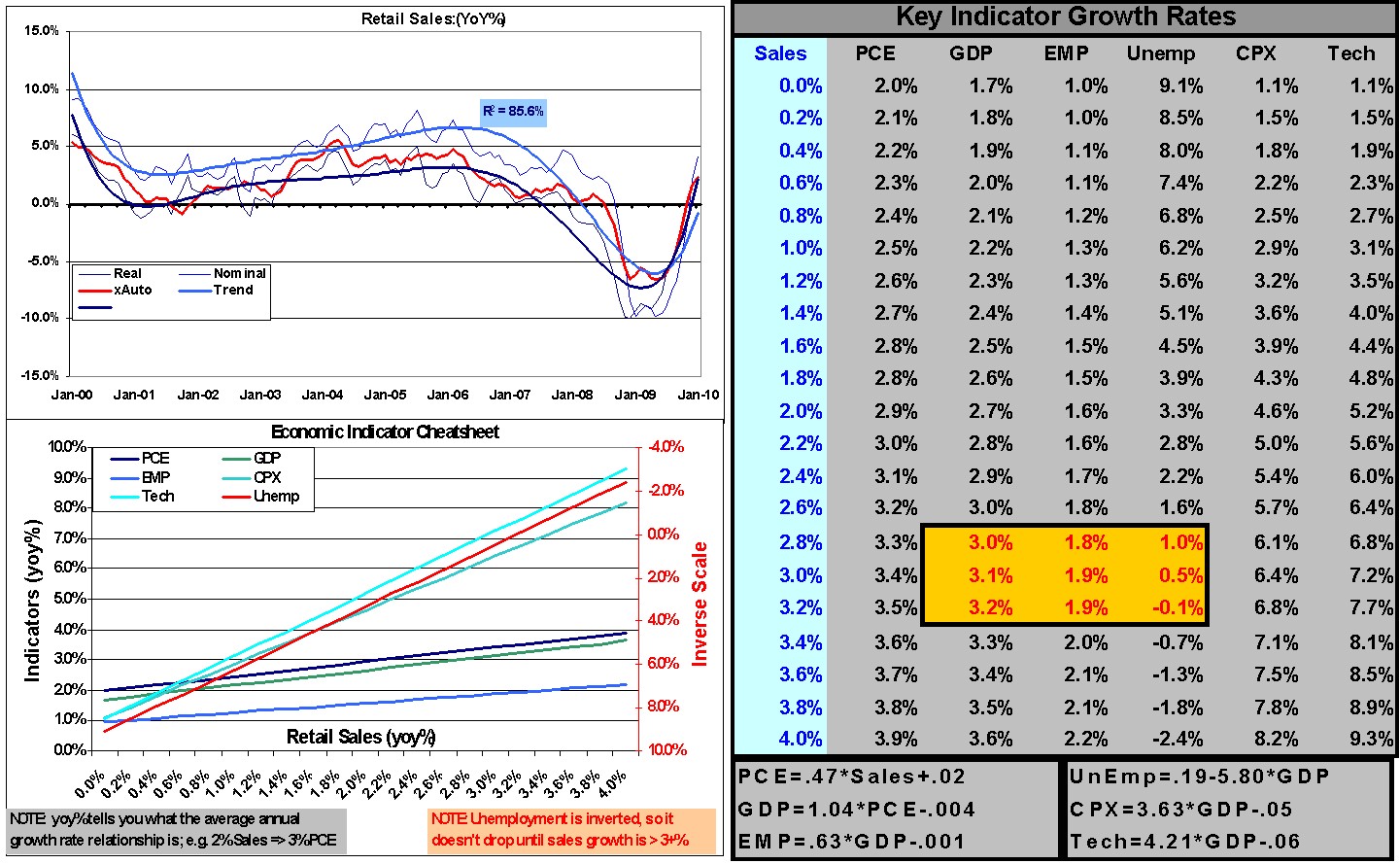
That is the question Dave Livingston of Llinlithgow Associates (he blogs at BizzXceleration) was considering perusing when he noticed one metric in particular stood out: Retail Sales.

So Dave did what any good econo-geek would do — he a regression analysis between YoY changes in retail sales and other key indicators.  (See composite chart of Retail Sales, with
his Cheat Sheet table, below).

Dave acknowledges this “cuts some corners, but it might serve a useful quicklook purpose.” How? Every time there’s a new sales report you can guestimate GDPEmploymentConsumptionInvestment changes.
It also operates on another level as a brutal reality check — look at what GDP growth rates are required to get Unemployment down from these levels.

Dave adds that despite all the caveats to this, the table below is a great thing to have in your wallet the next Wonk Dinner Party you attend — just whip it out and read off the economic outlook based on the latest headline!
>
click for larger graph

Sunday, February 14, 2010

FForecasting with a Grain of Salt

Forecasting with a Grain of Salt
by Michael Panzner

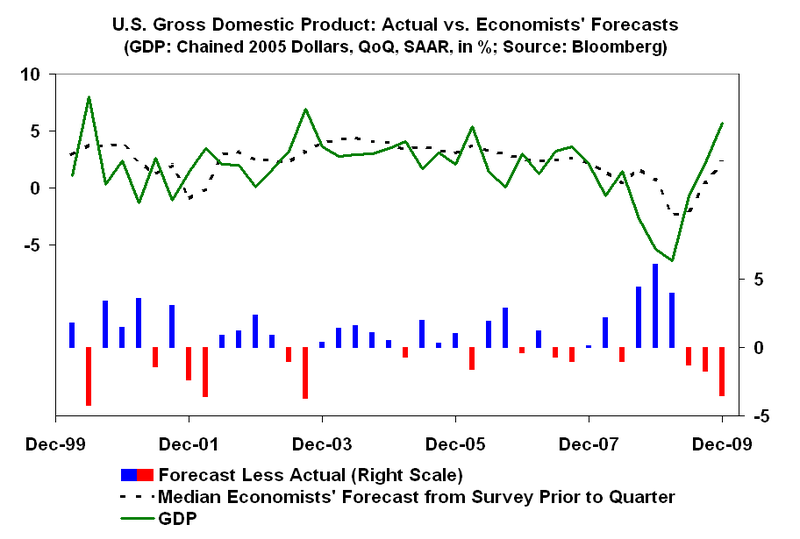
Bloomberg News is out with its latest monthly survey of economists’ forecasts and, according to those polled, the U.S. economy “will grow 3 percent this year and next, more than anticipated a month ago.”
Good news, right?
Well, maybe not. If you go back and look at how the experts have fared when forecasting the pace of growth for any given quarter, let alone for the year ahead, their tea leaf reading skills have left a lot to be desired.

Based on an analysis of Bloomberg monthly surveys published just prior to or at the beginning of each quarter over the course of the past decade, the professional prognosticators as a group have rarely been close to the mark.
Except for the last quarter of 2007, when the economists’ prediction (published in September) came within 5 percent of the reported result, the differences in percentage points between their estimates and the actual readings have been in the double digits — at a minimum.
In fact, on three occasions — the first quarter of 2000, the fourth quarter of 2002, and the third quarter of 2006 — the economists overestimated the pace of quarterly GDP by 1,133 percent, 2,400 percent, and 2,900 percent, respectively.
Aside from the fact that many of the so-called experts still haven’t quite figured out that what the economy has been going through is anything but a garden-variety downturn, their history of poor calls on the near-term outlook suggest their longer-term forecasts should be taken with a grain of salt.
~~~
http://www.financialarmageddon.com/2010/02/grain-of-salt-forecasting.html

Saturday, February 13, 2010

Obama unemployment forecasts


6) GRAPH OF THE DAY:
20100202 arra forecasts.xls

Bernanke’s Greatest Hits by Barry Ritholtz 2 people liked this Nice collection of Bernanke’s public comments, amounting to his cherry picked track record:


Bernanke’s Greatest Hits

Nice collection of Bernanke’s public comments, amounting to his cherry picked track record:
Popout
This video should make people think twice about listening to anything that Chairmen of the Fed Ben Bernanke says. It’s a compilation of statements he’s made from 2005-2007 that will have you 100% certain America is doomed if we continue to value what this moron says.

Wall Street Journal Forecasting Survey


Wall Street Journal Forecasting Survey (Whoopee)

Their mediocre track record not withstanding, it seems you just cannot stop the economic crowd from making forecasts.
The WSJ has the latest round up of gibberish:
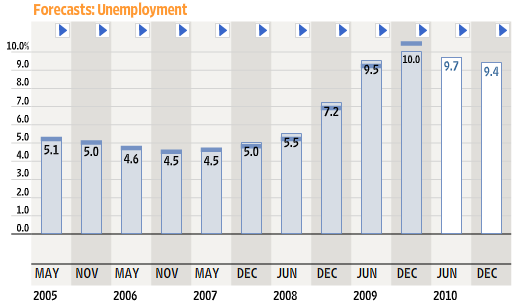
“About a quarter of the 8.4 million jobs eliminated since the recession began won’t be coming back and will ultimately need to be replaced by other types of work in growing industries, according to economists in the latest Wall Street Journal forecasting survey.
While the job market is constantly shifting as some sectors fade and others expand, this recession threw that process into overdrive. Thousands of workers lost jobs as companies automated more tasks or moved whole assembly lines to places like China. As growth returns, so will job creation—just with a different emphasis in the mix of jobs being created.
Economists in the survey are predicting a slow upswing for the economy as a whole. Respondents on average expect economic growth to settle at about 3% in 2010, off sharply from the powerful 5.7% seasonally adjusted annual growth rate in the fourth quarter.”
click for interactive graphic

>
Source:
Many Jobs Gone Forever, Economists Say
PHIL IZZO
WSJ, FEBRUARY 12, 2010
http://online.wsj.com/article/SB10001424052748703382904575059424289353714.html